
THE UPGRADE OF YAMAHA FZ16, WITH JUST MERE COSMETIC UPGRADES & PAINT SCHEME. ONLY THE PICTURES AS SPECS ARE THE SAME AS FZ16.
COLOURS:


THE UPGRADE OF YAMAHA FZ16, WITH JUST MERE COSMETIC UPGRADES & PAINT SCHEME. ONLY THE PICTURES AS SPECS ARE THE SAME AS FZ16.
COLOURS:

Each and every part of FZ16 has been designed with a lot of detailed attention and careful thought. This ultimate degree of perfection means even the slightest feature has not been overlooked. Only YAMAHA ensures this kind of craftsmanship. The rider and the machine share a feeling of oneness, and from different angles the impression is different. This is particularly because the finest components have been used in its precise manufacturing. The FZ16 possesses both a rough and brutish expression as well as a certain subtlety. This high quality masterpiece will without doubt become a rage for the next generation.
REVIEWS:
To start off this bike has striking presence. The looks of this bike will be a major reason for its success. We all know that the Pulsar 150 isint as great a bike as its sales figure suggests, its engine is not as refined either compared to the Unicorn but it does sell and how! One of the main reasons for the Pulsar 150 to sell so well is, it looks the part and the FZ16 makes the Pulsar look like a bike from last generation. After looking at the FZ16, i can confidently say that the bike is Definitely Male.
Just like the Yamaha R15, the FZ16 has been wind tunnel tested for better aerodynamics. The engine is air cooled and uses a carburetor. A FI version would have made this bike really more desirable but then Yamaha had to price it sanely too. However the bike does ride pretty well.
There is good amount of low end grunt, something which is missing in the R15. Though power of 14PS doesn’t speak much, its the torque which is worth talking about. 13.6NM @ 6000 RPM means this bike pulls very well from any RPM. There is very good throttle response and the bike will nudge 120kmph which is the norm in the 150cc segment. Yamaha claim an unrealistic mileage of 50kmpl. Expect 40kmpl under normal riding conditions.
The fat front forks, mono cross suspension and the fat tires ensures that the FZ16 rides very well. You hardly feel a bump and is thus suited for our roads, which are well poorly made. Although the bike looks all muscles, it handles pretty well. Change of direction is quick and the wide handle bars makes the riding position almost spot on. Braking is good and gear shifts are smooth but not as good as the R15, which is in another league.
I really didn’t like the instrumentation on the FZ16. The tacho needle is small and makes it difficult to read. Otherwise too the instrument cluster is a wee bit small for our liking and for a bike which looks so big and butch, i really don’t know why Yamaha compromised on better instrumentation. The bike also has no kick start (ala Pulsar 220), similar fuel tank capacity as the R15 (12 liters) and weighs just 127 kgs (dry)
To sum up the FZ16 is a fantastic machine, it is worth the money and is certainly our pick in the 150cc segment. However Yamaha could have made it better, all those fat tires and forks need a bigger engine, perhaps a FZ20 should be launched by Yamaha to quench the performance hunger in us.
SPECS:
ENGINE
Engine type Air-cooled, 4-stroke, SOHC, 2-valve
Displacement 153.0cm3
Bore & Stroke 58.0 × 57.9mm
Compression ratio 9.5:1
Maximum output 14PS / 7500 rpm
Maximum torque 14 N.m / 6000 rpm
Starting method Electric starter
Lubrication type Wet sump
Carburetor type BS26
Clutch type Constant mesh wet multiplate
Ignition type CDI
Primary/secondary reduction ratio 3.409 / 2.857
Transmission type Return type 5-speed
CHASIS
Frame type Diamond
Suspension (front/rear) Telescopic / Monocross
Wheelbase 1,335mm
Brake type(front/rear) Hydraulic single disc / drum
Tire size (front/rear) 100/80-17 / 140/60-R17
DIMENSIONS
Overall Length × Width × Height 1,975mm × 770mm × 1,045mm
Seat height 790mm
Wheelbase 1,335mm
Minimum ground clearance 160mm
Dry weight/Curb weight 126 kg / 137 kg
Fuel tank volume 12 liters
Engine oil volume 1.2 liters
FEATURES
ENGINE
"Air-cooled, 4-stroke, single-cylinder 153cc engine"

A newly designed 153cc air-cooled, 4-stroke, SOHC, single-cylinder, 2-valve engine with a max.output of 14 Ps and a max. torque of 14 N.m., characterized by its breathtaking pick up and featuring an electric starter.
SUSPENSION
"Monocross suspension adopted"

A Monocross rear suspension unit provides 120 mm of wheel travel, while optimized oil and damping valve specs help ensure agile running performance and handling. It inhibits bottoming while riding with a tandem passenger as well as providing a very comfortable ride.
MUFFLER
"Exhaust efficiency, sound and concentration of mass"

To give a sense of volume to the machine, an external diameter of 35mm is adopted in a two-layer type exhaust to minimize the effect of heat on the pipe. The layout features a large-volume primary character on the underside of the crankcase. The muffler is an irregular shaped tapered type mid-ship muffler.
REAR TYRE
"India’s first “140/60-17” size radial tyre (rear)"

The rear tyre is India’s first radial tyre with a 60% aspect ratio. Both the front and rear tyres on this model are tubeless type that are less susceptible to sudden flattening should the tyre be punctured.
DISC BRAKE
"Large-diameter front disc brake adopted"

At the front, a large Ø267mm disc brake is adopted. The two-pot caliper makes full use of the outer perimeter of the disc to provide strong stopping power. The optimized specs of the operational parts provide a high-level of balance, excellent initial braking performance and good operational touch.
FRONT SUSPENSION

The inner tubes on the front fork are the first large Ø41mm units adopted on a motorcycle made in India and the stroke is a generous 130mm. With the front assembly dimensions, they provide good shock absorption. The good damping characteristics during acceleration and braking contribute to increasing stability.
HEAD LIGHT
"Multi-reflector headlight adopted"

The bulb’s illumination and the type of light unit employed gives greater freedom of design. This creates an aggressive-looking front view and the transparent lens gives this unit a highly stylish image that accentuates the character of the model’s ride.
FUEL TANK
"12-liter fuel tank with uniquely styled plastic resin cover"
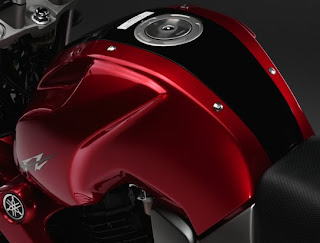
The steel fuel tank with a plastic resin outer cover takes advantage of the freedom of shaping that plastic provides, giving the tank cover a powerful shape with modulations suggestive of the muscular body of an athlete.
LCD METER
"Full LCD meter"

The meters on the FZ16 are installed in a Full Liquid Crystal Display. The speedometer, tachometer, trip meter, fuel gauge and other indicators are set in optimum position to keep the field of vision clear. Also, the engine starting signal is an example of the spirit of innovation.
SUM UP
Whats Kool
Looks amazing
Rides very well
Engine has good grunt
Attention to detail
Fat tires
Good pricing
Whats UnKool
Unimpressive instrument cluster
Pillion seat too small for humans
COLOURS:


The all New TVS APACHE RTR 180 the sure R15 killer!!!
Pics for now... reviews later


YAMAHA YZR R15
ENGINE
Egine type Liquid-cooled, 4-stroke, SOHC, 4-valve
Cylinder arrangement Single cylinder
Displacement 149 .8cc
Bore & Stroke 57×58.7mm
Compression ratio 10.4:1
Maximum power 17PS / 8,500rpm
Maximum torque 15 N.m / 7,500rpm
Starting system Electric Start
Lubrication wet sump
Engine oil capacity 1.0 liters
Fuel tank capacity 12 liters
Fuel supply system Electronic fuel injection
Ignition system T.C.I
Primary / Secondary reduction ratio 3.042 / 3.000
Clutch type Constant-mesh wet multi-plate
Transmission type Return type 6-speed
Gear ratios 1st=2.833, 2nd=1.875, 3rd:=1.364,
4th=1.143, 5th=0.957, 6th=0.84
CHASIS
Frame type Deltabox Frame
Caster / Trail 26° / 100mm
Tire size (Front / Rear) 80/90-17 / 100/80-17
Brake type (Front / Rear) Hydraulic, single disc (Front / Rear)
Suspension type (Front / Rear) Telescopic / Linked type Monocross
Headlight 12V35W / 35W+35W
DIMENSIONS
Overall length x width x height 1,995mm x 670mm x 1,070mm
Seat height 790mm
Wheelbase 1,290mm
Minimum ground clearance 160mm
Dry weight / Curb weight 120kg / 131kg
DETAILED SPECS:
Liquid-cooled
First India-made model with cooling method in the Indian market! Liquid-cooled engines provide stable performance, reduce vibrations, and offer a high quality ride.
One characteristic of YZF-R15’s new engine is that it is liquid-cooled. The engine is surrounded by a water jacket in which coolant liquid circulates to cool the engine. While this method is widely used in automobiles and large capacity motorcycles, there are very few examples of motorcycles of this class due to increased weight from components such as radiators. YZF-R15 uses a special compact and lightweight aluminum radiator and a body design that utilizes airflow for heat dissipation. This has enabled us to create a lightweight, compact body while retaining its stable performance.
The benefits of using this method include stable performance during long-distance, high-speed riding and hill climbing. A liquid-cooled engine does not need heat-dissipating fins and therefore the engine is able to deliver its best performance without being affected by temperature. Additionally, because the head and cylinder are enclosed in a water jacket, mechanical noise from the engine is reduced dramatically.
The newly developed engine delivers agile riding performance, and excellent performance on straight stretches of road as well as on winding roads. YZF-R15 also delivers excellent environmental performance. These traits are a must for an “urban supersport.” The ride is unprecedented in terms of both excitement and quality.
DiASil Cylinder
The DiASil Cylinder was born from YAMAHA’s world-class aluminum die casting technology.
DiASil Cylinders are all-aluminum cylinders made by YAMAHA’s proprietary aluminum die casting technology. An aluminum alloy with 20% silicon content is used to create a very hard, reliable cylinder surface, making conventional iron sleeves obsolete. As a result, the entire cylinder can be made of aluminum, a better conductor of heat, which means the cylinder delivers better heat dissipation and less weight. (Aluminum’s heat conductivity is 3.1 times that of iron.)

YZF-R15 is equipped with this all-aluminum cylinder called the DiASil Cylinder and a forged piston, the same type of piston used in YAMAHA’s supersport bikes. The fact that both the piston and cylinder of YZF-R15 are all-aluminum ensures excellent heat dissipation, eliminates heat-induced engine power loss, and helps improve fuel efficiency. The DiASil Cylinder is given a special surface treatment to prevent oil evaporation from the cylinder’s surface and improve oil consumption. The cylinder also has excellent hardness and is considerably resistant to wear compared to conventional iron sleeves.
Additionally, the piston is made in a forging process, the optimum way of achieving lightweight designs.The reciprocating mass with the forged piston is approximately 20% less ( according to Yamaha test ) than with an engine of the same displacement fitted with a conventional cast aluminum piston. Resulting in an invigorating feeling when revving up.
Conventional pistons are typically made in a casting process where molten aluminum is cast in a mold. YAMAHA developed its proprietary “controlled forging technology” in 1997, which enables mass production of forged aluminum pistons. These pistons have been used in sport models such as the R series. The same manufacturing process was used to develop YZF-R15. Forged pistons retain the excellent strength of aluminum alloys because the metallurgic matrix of aluminum is not affected during the fabrication process. Therefore, the piston can be made lighter and thinner.
YZF-R15 is packed with state-of-the-art technology that is used in the world’s supersport bikes.
Fuel Injection
Fuel injection is used to ensure excellent fuel efficiency as well as environmental friendliness.
The two components of the fuel injection mechanism used in YZF-R15, a) the sensors that gather information on the engine’s operation, and b) the fuel supply system that supplies gasoline, have both been designed to be lightweight and simple. The sensor component uses only 4 sensors (Red blinking points) to gather large amounts of information relating to engine operations, which is sent to a small 26-pin ECU, which in turn calculates the optimum fuel supply. The fuel supply component consists of a small, fuel pump, modularized regulator and filter, and a small injector, all of which come together to enable a lightweight, compact form. The injector injects finely atomized spray of fuel through 6 hole type injectors.


In order to maximize the efficiency of the fuel injector, which injects the optimum amount of fuel for different amounts of intake air, YZF-R15 is equipped with a large 3-liter air cleaner. The duct area of the intake duct was designed optimally to optimize the flow of intake air.
Additionally, the use of a 4-valve combustion chamber (a combustion chamber with 2 intake and exhaust valves each) has allowed designers to layout the spark plug at the center of the combustion chamber for better flame propagation. This also increases the total valve area relative to the 2-valve chambers for improved intake/exhaust efficiency (volumetric efficiency). YZF-R15 is fitted with a hemispherical 4-valve combustion chamber, a configuration that allows intake and exhaust valves to be laid out in the smallest size possible.
In addition, the intake and exhaust valve angles have been kept small to achieve optimum combustion chamber configuration. We also aimed at minimizing the surface area/volume ration (S/V ratio) in the combustion chamber, which is key to improving fuel efficiency. In conjunction with the fuel injection system, this combustion chamber contributes to comfortable riding during long-distance rides as well as during medium to high-speed riding.
YZF-R15’s engine delivers excellent response, fuel economy, is environmentally friendly and a comfortable ride.
CHASIS
Deltabox Frame
The frame, which forms the basis for riding comfort and handling performance, is a Deltabox frame which delivers superior rigidity balance.

This frame was designed to provide the best balance in longitudinal, lateral, and torsional rigidity. The synergy created by optimizing each dimension delivers a solid riding feel as well as comfort and agile riding performance.
The Deltabox frame was commercialized based on the experience and know-how accumulated through YAMAHA’s involvement in Moto GP since the early 1980s. This type of frame is currently used in YAMAHA’s R series of sport models. The engine is mounted on rigid supports; one on the head side and two on the case side; so that the engine itself becomes a structural member contributing to body strength and rigidity. The engine’s low vibration makes rigid supports possible, ensuring low vibrations and excellent balance of rigidity. Torsional rigidity refers to the frame’s resistance to deformation when a twisting force is applied to the pivot with the frame’s head pipe held in place.
Linked type Monocross suspension
YZF-R15 is equipped with a linked type monocross suspension that delivers a comfortable ride and a cushioning performance that is less prone to bottoming out. In particular, it reduces annoying “sinking” when riding tandem.


The linked monocross suspension consists of a link mechanism sandwiched between the rear arm and cushion unit to create changes in the lever ratio based on the lever effect. When the shock absorber is almost fully extended, the lever ratio is high and therefore the spring is soft, and the damper works softly as well. As the shock absorber strokes in, the lever ratio gradually decreases and the spring rate increases. Eventually, when it is nearly fully stroked in, the lever ratio becomes small and the spring becomes hard and strong. The damper also becomes hard. By making changes to the lever ratio in this way, we were able to achieve soft riding comfort as well as excellent damping under intense load conditions.
The optimization of the frame and rear arm rigidity of the Deltabox Frame combined with the effects of the linked type monocross suspension achieve good riding comfort, agile handling, and turnability, hardly ever causing bottoming out.
As the heir to the YAMAHA R series, YZF-R15 has inherited the series’ agile handling performance.
DESIGN
The “R” Design
This characteristic of motorcycles designed by YAMAHA as represented by the R series reflects the philosophy running through these models -- expressing performance visually.


For example, YZF-R6 shows a strong body line that springs up in a single line from the rear axle to the pivot and then to the head pipe. This is a visual expression of the straight shape of the Deltabox frame. These elements are a visual expression of “frame rigidity.” Viewed from the side, the shape created by the side panel and the upper surface of the tank creates an impression of the center of gravity shifting to the front tire. This is a visual representation of how the front tire grips the road in its sporty running performance. Needless to say, YZF-R1, with its athletic build, is also a visual expression of performance. A characteristic of the R series is that, when you view the machine, you get a sense of its concept and performance.
This philosophy has been fully transmitted to YZF-R15. An important point to note is that this motorcycle is not a scaled-down version of YZF-R1 or YZF-R6. YZF-R15’s design is based on having an excellent engine cooling method.
The shape of the cowling around the radiator area was determined so that the shapes of the air intake area and the rear outlet area where the air is scooped out are optimized to improve radiator efficiency. As for the outlet area, the mid-cowl area was designed using sculpturing 3D methods to create a three dimensional shape with a sense of volume. This resulted in an outlet area through which air is directed outwards with minimal resistance. We were able to present the new R series also in terms of design, and we have been able to maximize the performance of the liquid cooled engine, which will be a first for the Indian market.
When viewed from the front, it gives a sense of volume that seems well beyond its 150cc displacement. This does not simply mean that it is voluminous, but that it is grounded in the Art of Engineering which transforms function into art.
Humachine Technology
A sharp form that cuts through air. Inheriting the “R series” gene.

YZF-R1 and YZF-R6 are equipped with under cowls that are based on the image of a diffuser, to give them the best form for aero-management. These are not cowls for simply enclosing the engine, but forms composed of blade surfaces that actively control airflow. This spirit has been directly inherited by YZF-R15.
“Harmony between rider and machine.”YAMAHA’s Humachine Technology involves studying the form of the motorcycle actually in motion with the rider on it. The R series is the embodiment of 1) wide frontal space that protects the rider, 2) easy to ride seating area that gives riders the freedom of movement and allows them to steer effectively, 3) the glamorous tail treatment that takes into account the management of airflow behind the rider, and 4) a sexy racing form that brings all 3 of these elements together in a harmonious package. These characteristics have been splendidly reproduced in YZF-R15.
Additionally, the designs were developed in the same modeling room where YZF-R1 designers worked. Information was shared, ensuring that the R lineage would be transmitted. In addition, the model also incorporates a multitude of adjustments for the Indian market including seat shape that allows for tandem riding (integrated with the main seat), tandem grips that are easy to grip and also contribute to the supersport design, and a riding position that takes into account comfort, etc. In other words, YZF-R15 is characterized by a hybrid design that combines the world-class design of the “R” series with localized functions. YZF-R15 was created to lead the supersport category in India.
REVIEW
How does it look?
This bike is perhaps one of the best looking bikes in India. The design has been cloned from its dad, the Yamaha YZF R1. Except for a few minor changes including single silencer which does not fit under the seat as R1, it is almost R1 when looked from a distance. The dual head lamps, the rear view mirrors, shape of the tank, seating position all add up to a ‘WOW’ effect. This bike is definitely a head turner where ever you go.
To add to its looks, Yamaha did not include the center stand. This is perhaps the only bike in India which does not have a center stand. And another thing to notice is that the bike has no safety guard!
The handle bars are curved as it is in high-end sports bikes and adds to the grandeur of the sitting posture. Well, the rear part looks a bit disappointing because compared the front the rear looks too small and does not fit in with the whole bike’s look. I wished that Yamaha could provide some big manly tires, but I will justify this point in the performance review part below.
How does it perform?
When I was ready to take Yamaha YZF R15 for a test ride, I really did not expect much out of this machine. I thought it was just another 150cc bike with too much of external make up. But the actual ride did prove my thoughts wrong. Even with a pillion rider, the pickup was awesome. I went upto 30 kmph in the first gear easily without much resistance from the engine.
The bike vibrates a lot and it is not smooth, but users have reported that the engine sound really becomes nice and the bike becomes very smooth after riding 700-1000 kms. So do not let the test ride performance disappoint you!
The first thing that I felt (and the most important thing) is that the bike has a great acceleration in lower speeds but gives a great disappointment when you go above 60 kmph. I can boldly say that ‘Engine Size DOES Matter’, no matter what the technology, high displacement always feels great. But unfortunately except a few bike enthusiasts, most Indians need good mileage too.
The dashboard has the tachometer dial… the only dial and the digital console incorporates the fuel gauge, ODO meter and a bold speedometer.
Do not be disappointed about the thin tires. I heard from some bike owners that the thin tires actually perform very well, the bike is very stable even on wet roads. Yamaha engineers realized that along with great looks, indians also need mileage - hence the thin tires which reduces friction and consumes much less fuel. The bike is said to have a fuel efficiency of 40 kmpl in citis and 50 kmpl in highways.
From safety point of view, the bike performs great. The user’s have reported that the rear disc brakes does make a difference. It wouldn’t be long before all the high end bikes in India comes with compulsory rear disc brakes. The bike comes with mono suspension as in the Unicorn and claims to have better stability. But personally I don’t find a remarkable difference in mono-suspension.
Conclusion:
If you give high importance to the looks and status of owning one of the costliest bikes in India, go ahead and buy this bike. As for me I wouldn’t buy it because it is not a good justification to spend nearly one lakh and buy a 150cc bike. If it had a 250cc engine, I would buy it right now. Even though the bike may have 6 speed transmission and other advanced technologies, it will never be able to cover up the low displacement of Yamaha YZF R15 engine.
There needs to be a match in looks and performance. If I buy the the original 1000c Yamaha YZF-R1, it wouldn’t really make a great difference because people will think that it is R15 in the first look. The bottom line is, R1’s value has gone down! The brochure consists of too many feature indications like DAISIL cylinder, liquid cooled engine, 33mm front fork etc… but it doesn’t make much difference to a common man. In fact, it makes people feel ignorant and shy away from the bike.
COLOURS AVAILABLE:


Pulsar 220
On 25th June 07, Bajaj launched the much awaited Bajaj Pulsar 220 DTS-Fi in Delhi, along with its first Probiking showroom in the National Capital Region.
Pulsar 220 DTS-Fi, Bajaj’s first fuel injected bike, has what it will take to be at the top of the performance bikes segment. The long list of unique and futuristic features it comes with should leave bike enthusiasts’ hearts racing.
Pulsating new looks and raw power combined in the 220.
The country’s top three two-wheeler manufacturers have all dabbled in developing and testing fuel-injected engines. However, up until a couple of years ago, there was no interest among these manufacturers to come up with such an engine for their bikes.
Even now, the end to carburetion does not seem to be very near, though only two bikes in the market now have the feature. Fuel injection technology, when incorporated into the same bike, pushes up the cost when compared to its carburetted sibling. That was the case even for cars when fuel injection was introduced; buyers having had to pay a higher price.
However, the difference between cars and bikes is the fact that fuel injection had to be incorporated compulsorily in petrol-driven cars for them to be able to meet new emission standards. Whereas in the case of bikes, even though the current emission norms are among the most stringent in the world, they are being met just by adopting four-stroke technology and better exhaust systems, and despite the engine still being fed through a carburettor.
Naturally, there is not much pressure on two-wheeler manufacturers to adopt fuel-injection technology since it is not exactly necessary to meet any statutory emission requirements. The cost conscious customer in the lower half of the bike segment is also unwilling to pay more for a technology that does not offer any tangible benefits in terms of running costs.
TVS Motor says that it was one of the first to develop an in-house fuel-injected engine, though it never made it into series production. Hero Honda introduced its Glamour 125 with a similar sized fuel-injected engine and quickly managed to record it as the country’s first FI bike. However, the Glamour FI has not exactly managed to light up the market with its sales numbers. And being a bike in the fuel-efficiency and cost conscious buyer segment, the Glamour-FI was not destined to be the first choice when it continues to be offered alongside the carburetted version.
Bajaj Auto has come up with a more sensible product that features fuel injection. Logically, the buyer in the performance bikes segment is less sensitive to cost of ownership and will be willing to pay more for new technology that improves refinement and performance. He is relatively less fuel-efficiency conscious and will pay more if he is offered exclusive technology and features. So, choosing to launch its own version of fuel injection technology in the big-engined Pulsar 220 was probably the better strategy to adopt.
The Bajaj Pulsar 220 DTS-Fi was launched exclusively in Pune and Mumbai in the first quarter of this year. It has only now been rolled into dealerships nationwide after a six-month observation period, during which Bajaj ironed out product and production issues for the Pulsar 220. The wait was probably a good idea given the fact that the bike has what it will take to be at the top of the performance bikes segment. 
The Pulsar 220 DTS-Fi is Bajaj’s first fuel injected bike. It shares quite a bit with the rest of the Pulsar pack and yet Bajaj has managed to load it up with enough unique, futuristic features to leave current bike buyers drooling.
Though from the front, the new top-end Pulsar seems like it is an all-new bike, at the rear, it gives away its lineage. The same alloy grab rail, the same twin LED strips at the rear tail lamp, a similar stepped, split seats for the rider and pillion and the same sharp body side panels as was featured in the Pulsar 200, continue to be available in the 220 DTS-Fi.
Refined features
The new Pulsar and its refined features seem to be like the culmination of Bajaj’s attempts at developing unique new features that have been adopted step by step into every variant of the Pulsar.
The LED tail lamp, the non-contact, backlit type switches, the digital speedometer etc., have been carried forward into the 220, and serve to further reiterate the new bike’s bloodline.
But to mark the new bike’s top-of-the-line positioning, Bajaj has endowed it with even more attractive, hi-tech features like the new headlamp cluster, the clip-on handle bars, the fuel-injected engine, rear disc brake and the new body side cladding, which gives the 220 its big bike looks.
At the front of the new Pulsar, Bajaj designers and engineers have come up with a new, broader bikini fairing that houses a new type and arrangement of bulbs. 

While the twin pilot lamps have been retained on either side, the low beam and high beam bulbs have been stacked one on top of the other and now housed inside projector glass shells instead of the usual mirrored reflector.
The high beam is a compact clear lens parabolic lamp and the low beam is an ellipsoidal projector lamp. The halogen bulbs are high wattage (55W) type and are connected to the battery sourcing DC power and thereby ensure no voltage fluctuations affect the light output. The end result is a headlamp arrangement that enables the bike to offer illumination at night that almost rivals that of a car.
Mounted next to the tinted cowl are the two rear view mirrors. They are compact units with short stubs and are rubber mounted right on to the fairing, giving the bike a classy, very unique front finish. However, due to the size and positioning, they do seem to reduce the level of rear visibility for the rider.
Wrapping around the fuel tank and flowing away from the new, broader fairing is the unique plastic side cladding that adds to the Pulsar 220 DTS-Fi’s macho image.
While the same chunky fuel tank of the smaller-engined siblings has been carried forward for the 220 too, the new panels cover much of the tank. The panels are well finished and panel gaps have been minimised, though the bits of the road whizzing past that the rider gets to see can at times be distracting.
The digital instrument cluster (speedo) that has been made standard in all Pulsars is also featured in the 220 DTS-FI, only this time around there are a few more warning lights that attempt to provide timely information to the user. With a more sensitive and hi-tech fuel injected engine, the 220’s digital instrument panel also features a choked air filter indicator, high oil temperature and low battery voltage indicators and a low engine oil level warning lamp.

There is also an engine malfunction indicator that doubles up as a low fuel (reserve) indicator. Since the ‘Fi’ engine uses an electric fuel pump, the low fuel indicator is important so that the bike doesn’t end up with a pump failure.
That long list of novel features that Bajaj has come up with for its new benchmark in performance biking doesn’t end here. Adorning the six-spoked, 17-inch alloy wheels are new tubeless tyres, a first for an Indian bike.
Tubeless tyres being lighter, more heat resistant and durable, will in the long run deliver good performance for discerning buyers in this segment.
The 230mm disc brakes in the rear wheel, in addition to the 260mm disc with twin calipers in the front, also ensure more sure-footed braking for a bike that is clearly the most powerful in this segment.
The thick elliptical swing arm, the naked chain and the ‘fat-boy’, matt-silver finished silencer are all features that further boost the Pulsar 220 DTS-Fi’s street-racer image. Exhaust note of the 220 is soft, yet raspy and gets progressively loud at higher engine rpms.
Technology showcase
The engine in the new Pulsar 220 DTS-Fi is the technology showcase for Bajaj. Developed in-house, this bike’s engine features fuel injection instead of the conventional carburetion. DTS-Fi or digital twin spark fuel injection continues to have two spark plugs like in the other Pulsars.
However, instead of the carburettor that enables the other Pulsar engines to breathe and take in fuel, the 220 DTS-Fi engine features an injector that sprays fuel directly into the combustion chamber. In turn, an electronic control unit (ECU) regulates the injector. The ECU is a microprocessor-based system that is the command centre of the engine and bases its instructions to the fuel-injector on the feedback it receives from an array of sensors.
The ECU considers various parameters such as engine temperature, throttle position, engine speed, etc., before sending the relevant command to the injector ensuring optimum fuelling and spark timing under different operating conditions.
Power packed
Making the 220 a fuel-injected engine has enabled Bajaj to squeeze out the most power from the bike. Bajaj’s in-house ExhausTEC resonator technology for improving torque at low engine rpm has also been carried forward into the new 220.
The bike’s throttle response, ability to accelerate in spurts and the amount of low-end torque available in each gear slot is testimony to the benefits that fuel injection has brought to this engine. The 220 DTS-Fi generates a class-leading peak power of 20PS and a maximum torque of 19.12Nm at 6,500 rpm.
The Pulsar 220 DTS-Fi comes with a five-speed gearbox with the internationally popular first down, rest up shift pattern. Gear shift quality and clutch feedback are good, with false neutrals also being almost non-existent. While the toe-shifter adds to the overall big bike image of the Pulsar 220, the absence of the heel shifter may irk some users.
The front fixed fairing and large side panels will also need some getting used to for bikers who have recently upgraded from the lower ‘cc’ segments, where the fairing is mounted to the handle bar. This issue will come up when bikers attempt to ease out the bike from particularly tight parking slots that are the norm in most cities in India.
Priced at about Rs 80,000 (ex-showroom), the Pulsar 200 DTS-Fi doesn’t come cheap. But, it is loaded enough to take on competition and, in fact, could set a new benchmark in the premium performance bike segment.
vehicle summary:
Engine:
ENGINE TYPE : 4-Stroke, DTS-Fi
DISPLACEMENT : 220cc
MAXIMUM POWER : 20 PS @ 8500rpm
MAXIMUM TORQUE : 19.12 Nm @ 6500rpm
ACCELERATION : 0-60 Kmph in 4.0 Seconds
TOP SPEED : 135kph
STARTING : Self Start/Kick Start
IGNITION : Digital Twin Spark Fuel Ignition
COOLING TYPE : Oil-Cooling
TRANSMISSION:
CLUTCH : Multi-Disc Wet Type
GEAR BOX : 5 Speed Costant Mesh
CHASSIS TYPE : Tubular Double Cradle
SUSPENSION:
FRONT : Telescopic, 130mm Stroke
REAR : Mono Tube 5-Step Adjustable Canister - Gas Filled Shock Absorbers
BRAKES:
FRONT : 260mm, Twin Calipers Disc Brake
REAR : 200mm, Single Caliper Disc Brake
WHEELS AND TYRES:
WHEEL TYPE : Alloy
TYRE TYPE : Tubeless
TYRE SIZE(FRONT) : 90 x 90 - 17
TYRE SIZE(REAR) : 120 x 80 - 17
FUEL TANK:
FUEL CAPACITY : 15 Ltrs
FUEL RESERVE : 3 Ltrs
DIMENSIONS:
LENGTH : 2035.00 mm
WIDTH : 750.00 mm
HEIGHT : 1165.00 mm
WHEELBASE : 1350.00 mm
GROUND CLEARANCE : 165 mm
KERB WEIGHT : 150 Kg.
COMFORT AND CONVENIENCE:
FUEL GUAGE : Digital
TACHO METER : Analogue
TRIP METER : Digital
SPEEDOMETER : Digital
SELF START : Available
LOW FUEL INDICATOR : Available
LOW OIL INDICATOR : None
LOW BATTERY INDICATOR : None
FUEL CONSUMPTION(CITY) : Around 35 Km/Litre
FUEL CONSUMPTION(HIGHWAY) : Around 45 Km/Litre
colours available:


and the one Limited edition Chrome

Interesting screen shots:


